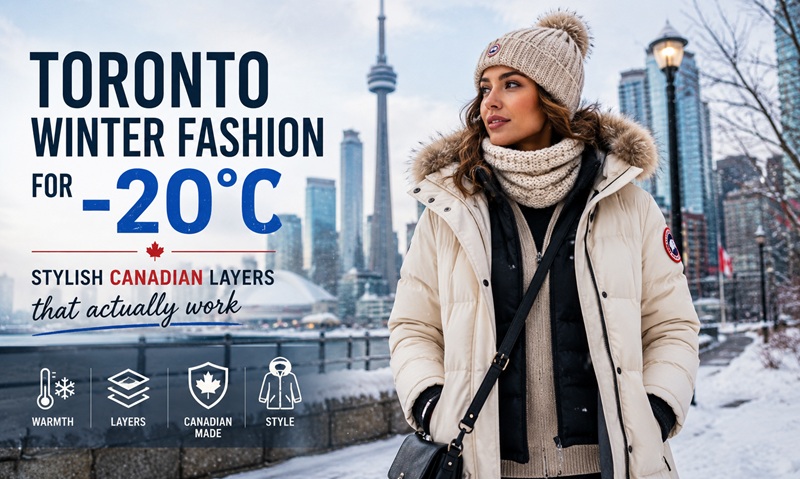
Toronto winters have a way of humbling people who move there from milder climates. It’s not just the temperature — it’s the wind off Lake Ontario, the ice underfoot, the grey skies from November to March, and the gap between the heated indoor world and the brutal exterior that makes dressing right genuinely important. At -20°C, fashion becomes functional or it becomes a problem.
This guide is specifically for people who want to dress well in Toronto winter at real temperatures, not just on the mild days.
Why Toronto Winter Is Different From “Cold”
Some cities are cold in a manageable way. Toronto is cold in a way that requires a system. The combination of lake-effect wind, temperatures regularly hitting -15°C to -25°C with windchill in January and February, and the constant transit between extreme cold and overheated indoor spaces demands wardrobe planning that goes beyond “buy a puffer.”
The Three-Layer System for Toronto at -20°C
Layer 1: The Base — Thermal Management
At -20°C, your base layer is doing critical work. Options:
Best choice: Merino wool base layer (long-sleeve top and thermal leggings or long underwear). Merino stays warm even when slightly damp from perspiration, doesn’t smell after wear, and is thin enough to wear under fitted clothing.
Second choice: Synthetic thermal base layers (Under Armour ColdGear, Lululemon base layers) — excellent at moisture-wicking, slightly less comfortable against skin than merino but easier to care for.
Avoid: Cotton thermal underwear. Cotton retains moisture and becomes cold when damp, which defeats the purpose entirely.
Layer 2: The Mid-Layer — Insulation
This layer traps warm air. At -20°C, it needs to be substantial:
- A chunky knit sweater (wool or wool-blend) — traditional, effective, looks good
- A down vest — worn over a knit, adds core warmth without restricting arm movement; popular with Toronto commuters
- A fleece mid-layer — technical option for people who commute on foot; less stylish but very practical
For going out in the evening, the mid-layer is often what’s most visible when you remove your outer coat, so it’s worth investing in one that looks good independently.
Layer 3: The Outer Shell — Weather Barrier
This is where the real protection happens. At -20°C, your options narrow:
The Canada Goose/Arc’teryx Question: Both are genuinely excellent and genuinely expensive. Canada Goose parkas (Expedition, Kensington styles) are rated to -30°C and are visible all over Toronto streets. Arc’teryx Beta jacket combined with a mid-layer achieves similar warmth with a more athletic profile. Neither is the only option.
More Affordable Alternatives:
- Moose Knuckles — Canadian brand, high quality, works at extreme temperatures
- Nobis — Toronto-based brand, solid quality at a slightly lower price point than Canada Goose
- Uniqlo Ultra Light Down or Ultra Warm Down Parka — genuinely good at temperatures to about -15°C; lower windchill protection than a parka
What matters in a Toronto winter coat:
- Fill power of at least 600 (higher is warmer and lighter)
- A genuine fur-trimmed or insulated hood for wind protection
- Length that covers the thighs — hip-length coats allow wind to cut straight through
Footwear: The Part That Most Newcomers Get Wrong
Toronto sidewalks after a snowfall — before they’ve been cleared — are sheets of compressed ice in the residential areas. After they’re cleared, they’re covered in salt, slush, and the residue of both.
Best options:
- Sorel Caribou or similar boot — rated to -40°C, completely waterproof, lined; ugly by some standards but genuinely effective
- Blundstone Chelsea boots in winter weight — surprisingly functional in moderate Toronto cold, look considerably better than snow boots
- Kamik winter boots — Canadian brand, good price-performance ratio, practical for everyday commuting
What to avoid:
- Leather-soled dress shoes below 0°C (ice risk, salt damage)
- Uninsulated ankle boots below -10°C
- Fashion boots without traction — Toronto crosswalks in January are skating rinks
Toronto Winter Style: Looking Good While Actually Warm
The city’s fashion community has solved this. A typical winter outfit on Queen Street West in January:
- A technical or down parka (often oversized)
- Straight-leg jeans or thick trousers
- A visible knit sweater peeking below the coat hem
- Snow-capable boots (Sorel or similar)
- Toque (wool beanie), scarf wrapped high, leather or insulated gloves
The style moves in Toronto winter tend toward utilitarian-meets-streetwear rather than the more fashion-forward European sensibility. Functionality is respected here.
Comparison: Toronto Winter Coat Options
| Coat | Temperature Rating | Style | Price Range |
|---|---|---|---|
| Canada Goose Expedition | -30°C | High — recognized | £650–£1,100 CAD |
| Moose Knuckles Parka | -25°C | High | £500–£900 CAD |
| Nobis Merideth | -20°C | High | £400–£700 CAD |
| Uniqlo Ultra Warm Parka | -15°C | Good | £150–£200 CAD |
| Patagonia Down Parka | -15°C | Good | £350–£500 CAD |
Pro Tips for Toronto Winter Dressing
- Never skip the toque — at -20°C windchill, bare ears become painfully cold in minutes; a wool or fleece beanie is non-negotiable
- Carry a crossbody bag or backpack — bulky gloves make opening bags difficult; streamline your carry to reduce fumbling
- Treat leather boots with waterproofing spray and re-apply monthly — salt is corrosive to leather; untreated boots won’t survive a Toronto winter
- Keep a pair of indoor shoes at work — changing out of snow boots at the office is standard Toronto professional practice
- Vaseline on exposed skin at extreme windchill — an old Canadian trick that genuinely prevents windburn
Common Mistakes to Avoid
- Buying a fashionable coat rated for -5°C and expecting it to work at -20°C — this is the most common newcomer error; always check the temperature rating, not just the look
- Wearing multiple thin puffer jackets instead of one proper parka — they don’t add up the same way
- Ignoring layers for the indoor-outdoor transition — Toronto moves between -20°C outside and 22°C inside constantly; build layers you can add and remove
FAQs: Toronto Winter Fashion
Q: Is Canada Goose worth it for a Toronto winter? If you walk outside for more than 10–15 minutes a day in January and February, a properly rated parka is worth the investment. Canada Goose is genuinely good, but so are Moose Knuckles, Nobis, and Patagonia equivalents.
Q: What do Torontonians wear in early winter (November–December)? November is the transitional month — temperatures average -1°C to 8°C. A mid-weight wool coat often works; by December, the heavier parka becomes standard. Most Torontonians own both.
Q: Can you wear a trench coat in Toronto winter? A treated trench is fine for October and early November. By January, it’s not adequate for sustained time outdoors. It can work as an indoor-to-car-to-indoor layer.
Q: Do Toronto offices have a different dress code in winter? The physical act of arriving in a full ski jacket and snow boots is so normal that most workplaces expect it and have entry areas for coat and boot storage. What matters is what you wear inside.
Conclusion
Dressing for Toronto winter at -20°C is fundamentally about system-building, not individual pieces. A proper base layer, a real mid-layer, and a coat actually rated for the temperatures you’re facing — those three things, done right, make January and February manageable rather than miserable. The style part follows naturally once you’re warm.
Buy the parka before your first November. You’ll be grateful by December.
Leave a Reply