
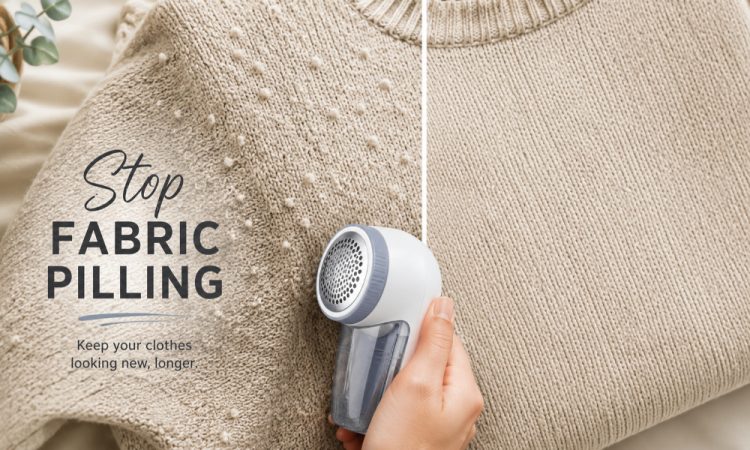
Those little fuzzy balls that show up under the arms of a sweater or across the inner thighs of leggings aren’t a sign you bought something cheap — they’re a predictable, physical reaction between fiber structure and friction. Understanding why pilling happens is the difference between blaming a garment and actually knowing how to protect it.
01 What Pilling Actually Is
Pilling happens when short, loose fibers on a fabric’s surface rub against another surface — skin, a bag strap, a car seat — and tangle into small knots instead of breaking off cleanly. Weaker or shorter fibers snap and twist together into a “pill,” while the fiber’s tensile strength determines whether that pill eventually falls off or stays anchored to the fabric, growing more visible over time. It’s fundamentally a friction-and-fiber-strength problem, not a hygiene or quality-only issue — even expensive garments pill if the fiber is short-staple or loosely spun.
Every fabric is made of countless individual fibers twisted into yarn, and every wear cycle causes some of those fibers to work loose at the surface. Tightly spun, long-fiber yarns keep most of that movement locked in place; loosely spun, short-fiber yarns don’t, which is why the same style of sweater can pill heavily in one brand and barely at all in another, even at a similar price point.
02 Who Deals With Pilling Most
✓ Sweater and knitwear owners — loose knit structures expose more fiber surface to friction.
✓ Activewear wearers — repetitive rubbing accelerates pilling in high-friction zones.
✓ Parents of young kids — car seats and backpacks cause fast pilling on outerwear.
✓ Budget clothing shoppers — shorter, weaker fibers pill faster, though not exclusively.
✓ Frequent travelers — luggage straps are an overlooked pilling cause.
03 Styling Tips to Minimize Visible Pilling
✓ Choose smoother, tighter-woven fabrics (combed cotton, merino) for high-friction areas.
✓ Layer structured outerwear over pill-prone knits to reduce direct friction.
✓ Rotate garments rather than wearing the same piece on consecutive days.
✓ Avoid rough-textured bags directly against soft knitwear.
04 Seasonal Considerations
✓ Winter — wool and cashmere see peak friction from coats, scarves, and bags.
✓ Summer — cotton and linen pill less overall, but underarm friction remains a spot risk.
✓ Year-round activewear — synthetic blends pill fastest from repetitive motion.
✓ Fall layering — multiple textured layers increase friction points on both garments.
05 Fabric Comparison: Pilling Resistance
| Fabric | Pilling Risk | Why | Durability |
| Long-staple cotton | Low | Longer fibers resist tangling | High |
| Merino wool | Low-Moderate | Fine but resilient fibers | High |
| Acrylic | High | Weak, short synthetic fibers | Low-Moderate |
| Polyester blends | Moderate-High | Fiber strength varies by weave | Moderate |
| Cashmere | Moderate | Soft fibers loosen easily | Moderate (with care) |
| Silk | Low | Smooth, long filament fibers | High (with care) |
As a rule, tighter weaves and longer fiber lengths resist pilling significantly better than loosely spun, short-staple, or heavily blended fabrics.
06 Common Mistakes That Cause or Worsen Pilling
✗ Washing pill-prone fabrics with rough items like jeans, zippers, and towels.
✗ Using high heat in the dryer — heat weakens fibers.
✗ Skipping the inside-out wash for knitwear.
✗ Over-washing delicate knits instead of spot-cleaning.
✗ Ignoring early pills, which attract more fiber tangling.
✗ Buying loosely knit garments for high-friction uses like under a backpack.
07 Budget vs. Premium Options
✓ Budget ($20–$50): Blended synthetics or short-staple cotton — expect visible pilling fast in high-friction zones.
✓ Mid-range ($50–$120): Tighter weaves and better fiber content reduce pilling.
✓ Premium ($150+): Long-staple cotton, fine-gauge merino, tightly spun cashmere resist pilling far longer.
Price correlates with pilling resistance, but care habits matter just as much — a mid-range sweater washed correctly will outlast a premium one that’s tumble-dried on high heat.
08 Expert Fashion Advice
Fashion and textile experts recommend a fabric shaver or pill comb over scissors — cutting pills risks nicking the fabric, while a shaver lifts pills cleanly from the surface. For prevention, washing knitwear in a mesh laundry bag on a gentle cycle, air-drying flat, and rotating garments between wears meaningfully extends fabric life. When shopping, gently rub a fingertip against the fabric in-store; if fibers immediately shed or fuzz, that garment is likely to pill quickly once worn.
It’s also worth checking the fabric’s blend percentage on the label before buying — a cotton-polyester blend with a higher synthetic ratio tends to pill faster in high-friction spots than a fabric that’s mostly natural fiber, even if the price tag suggests otherwise.
09 FAQ
| Q Does pilling mean low quality? | Not always — pilling relates to fiber length, weave tightness, and friction exposure, not price alone. Even luxury wool can pill under friction. |
| Q Can pilled clothing be restored? | Yes, a fabric shaver or pill comb removes existing pills and restores a smoother surface, though heavily pilled areas may show slight thinning. |
| Q Does washing inside out help? | Yes — it reduces direct friction between the fabric’s outer surface and the washing machine drum or other garments. |
| Q Which fabrics resist pilling best? | Long-staple cotton, silk, and fine merino wool, due to longer, stronger fiber structures. |
| Q Is dry cleaning better for pill-prone fabrics? | For delicate wool and cashmere, yes — it avoids the tumbling friction that accelerates pilling in a washing machine. |