
I’ve spent the better part of fifteen years with leather across my workbench — restoring vintage briefcases, authenticating estate-sale finds for resale clients, and fielding the same question over and over: “is this actually leather, or am I being sold particle board with a grain stamped on it?” That’s not far off. Bonded leather is, structurally, close to particle board — shredded leather fiber and scrap glued onto a fabric backing with polyurethane or latex, then embossed to look like a hide. It’s legal to call it “leather” in most markets, which is exactly why buyers get fooled. Below are the tests I actually use, in order, plus two situations pulled from my own buying mistakes.
What Bonded Leather Actually Is
Bonded leather isn’t a lower grade of hide the way “genuine leather” is — it’s a manufactured composite. Leftover tannery scraps are pulverized into a near-pulp, mixed with polyurethane or latex binder, and pressed onto a fiber backing sheet. Depending on the maker, that pulp might be 10% to 30% actual leather fiber, with the rest binder and backing. It can smell faintly like leather out of the box because there’s real hide dust in the mix, but it won’t age like leather — it cracks and delaminates instead of developing a patina.
Why This Distinction Actually Matters
I’ve replaced more bonded-leather bags for clients than I can count, and the pattern repeats: the piece looks fine for six months to two years, then the surface flakes at the corners and handle wear points, because the embossed top layer is only cosmetic. A full-grain or top-grain bag, properly cared for, is still functional after a decade. If you’re paying designer-adjacent prices, this difference is the entire value of the purchase.
Test 1: Check the Label, But Don’t Trust It Alone
Start here, but treat it as a first filter, not proof. “Full-grain” or “top-grain leather” is a strong signal. “Genuine leather” is technically real leather, but it’s the lowest tier of real hide — not a quality marker despite how it reads. If the tag says nothing about material at all, or uses vague phrasing like “leather look” or “vegan leather,” treat that as a red flag rather than reassurance.
Test 2: Examine a Cut or Unfinished Edge
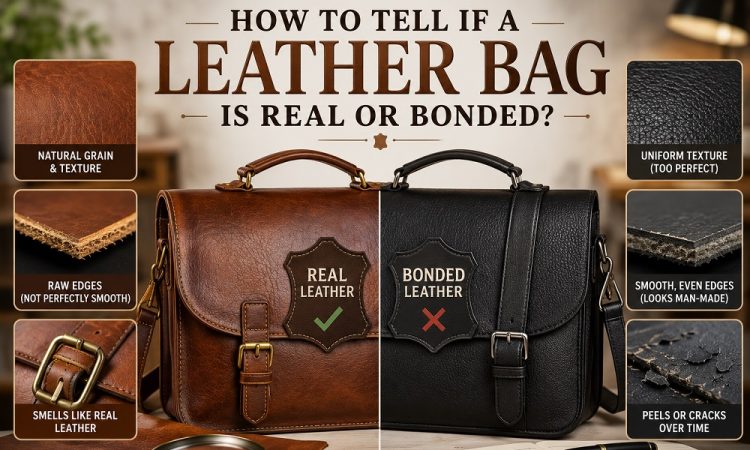
This is the single most reliable test I use, and it takes ten seconds. Find an edge that isn’t burnished or bound — inside a zipper pocket, along a strap fold, underneath a handle. Real leather shows a fibrous, slightly rough cross-section, like compressed layers. Bonded leather shows a flat, uniform edge with a visible fabric or fiber-mat backing under the printed top layer. Once you’ve seen the difference side by side, you’ll spot it instantly on every bag afterward.
Test 3: Study the Grain Pattern Up Close
Real hide has irregular pore placement — small clusters here, smoother patches there, because it came from a living animal, not a mold. Bonded and faux leather show a repeating, mechanically stamped texture; the same knot or wrinkle pattern will repeat every few inches if you look closely. Tilt the bag under strong light and scan a large flat panel rather than a small corner.
Test 4: Smell It
Real leather has a rich, slightly earthy, organic scent. Bonded leather often carries a chemical or glue-like undertone beneath a faint leather smell, since the binder is a large part of what you’re smelling. If you’re unsure, smell a leather item you already trust — a belt or wallet — for comparison before judging the bag in question.
Test 5: The Water Drop Test
Place a small drop of water on an inconspicuous spot. Real, minimally finished leather absorbs it slowly over 20–30 seconds, sometimes darkening slightly. Bonded and synthetic surfaces let the drop bead on top, since the polyurethane coating is essentially a plastic seal. Note: heavily finished genuine leather (patent, some saffiano) can also resist water, so don’t rely on this test alone.
Test 6: Hold It and Feel the Warmth
Hold a flat section in your palm for about twenty seconds. Genuine leather is porous and warms toward body temperature fairly quickly. Bonded leather, sealed under its polyurethane top layer, stays noticeably cooler for longer — a subtle but useful confirming signal.
Test 7: Press and Watch It Move
Press a knuckle gently into the surface. Real leather — especially full-grain — stretches and wrinkles slightly like skin, then slowly recovers. Bonded leather feels flatter and more rubbery, without that organic give, because the fiber mat beneath the coating doesn’t flex the same way natural hide does.
Real Leather vs. Bonded vs. Faux: Quick Comparison
| Signal | Real Leather (Full/Top-Grain) | Bonded Leather | Faux/PU Leather |
| Edge texture | Fibrous, layered | Flat, fabric backing visible | Smooth, plastic layers |
| Grain pattern | Irregular, non-repeating | Repeating stamped texture | Repeating stamped texture |
| Smell | Earthy, organic | Faint leather + chemical | Plastic, no organic scent |
| Water drop | Absorbs slowly | Beads on surface | Beads on surface |
| Typical lifespan | 10–20+ years, develops patina | 6 months–2 years before cracking | 6 months–2 years before cracking |
Real-World Scenario: The Thrift-Store Briefcase
A client once brought me a vintage-looking briefcase she’d found for $18, convinced she’d scored a designer deal. The label said “genuine leather,” and the surface felt reasonably supple. The edge test told the real story within seconds: under the strap fold, the cross-section was flat and uniform, with a thin fabric mesh visible beneath the printed grain — classic bonded leather construction. Not a bad bag for $18, but not the investment piece she thought she’d found.
Real-World Scenario: Buying Resale Online
Online, you lose the edge and smell tests, so lean on the seller’s language and photos instead. Ask specifically what grade of leather it is — a seller who confidently answers “full-grain” or “top-grain,” and includes close-up photos of an interior seam or unfinished edge, is far more trustworthy than one who just writes “leather” in the title. If a price sits dramatically below comparable full-grain pieces from that brand, treat that gap as information, not a lucky break.
Actionable Takeaways
- • Run the edge test first — it’s the fastest, most reliable check and works on almost any bag.
- • Never rely on a single test; combine at least two (edge plus smell, or grain plus water drop) before concluding.
- • Treat “genuine leather” as real but low-grade, not as a quality guarantee.
- • When buying online, request close-up photos of an interior seam or edge before you commit.
- • Expect bonded leather to show wear within six months to two years — budget your purchase accordingly.
FAQ
Is bonded leather considered real leather?
Technically it contains real leather fiber, but it’s a manufactured composite — shredded leather scraps bonded to a fabric backing with polyurethane or latex — not a cut or split of hide. Most experts and retailers don’t classify it as genuine leather in practice.
What’s the fastest way to check a bag in a store?
Find an unfinished or cut edge — inside a pocket, under a strap fold — and look at the cross-section. Fibrous and layered means real leather; flat and uniform with visible fabric backing means bonded.
Does bonded leather smell like real leather?
It can smell faintly like leather because it contains real hide fiber, but it usually carries an additional chemical or glue undertone from the polyurethane binder.
How long does bonded leather actually last?
Typically six months to two years of regular use before the surface layer starts cracking or peeling, compared with a decade or more for well-maintained full-grain or top-grain leather.
Can the water drop test be wrong?
Yes. Heavily coated or finished genuine leather, such as patent or some saffiano finishes, can also repel water. Always pair the water test with the edge or smell test rather than relying on it alone.