

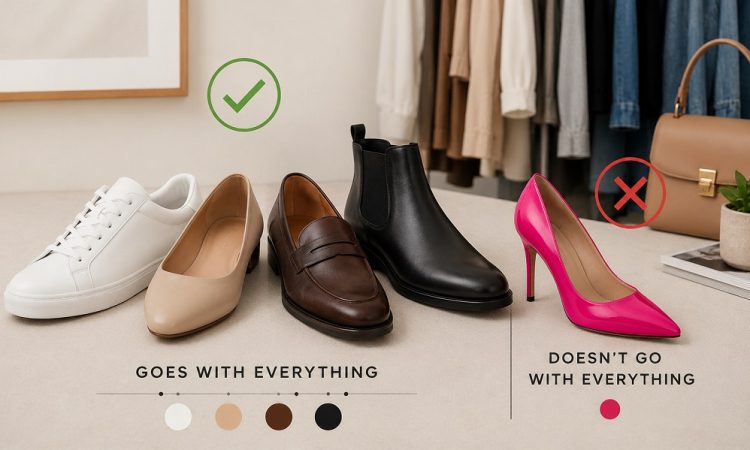
Black, beige/nude, and gray are the shoe colors that go with everything, because they’re low-saturation neutrals that don’t compete with any outfit color. Bright orange is the color that goes with the least, since it’s a highly saturated warm hue that clashes with both cool-toned and other warm-toned outfits rather than blending into either.
What Shoe Color Goes With Everything?
Black, beige (or nude), and gray are the three shoe colors that pair with nearly any outfit. They work because they’re neutral — low in saturation, without a strong color cast — so they don’t fight for attention against whatever color you’re already wearing. Black leans formal and grounds bright colors; beige and nude blend into skin tones and soften an outfit; gray sits between the two, working with both warm and cool palettes.
- • Black: pairs with every color family, reads formal or casual depending on the shoe style.
- • Beige/nude: elongates the leg line and disappears into most outfits, especially dresses and tailored pants.
- • Gray: softer than black, works with pastels, jewel tones, and other neutrals alike.
- • White: close behind the top three — extremely versatile in casual and smart-casual settings, less so in formal wear.
- • Tan/brown: the default with warm-toned outfits (olive, rust, mustard, cream).
- • Metallics (soft gold, pewter, brushed silver): function as a modern neutral, especially for dressier looks.
Why Does Black Go With Almost Every Outfit?
Black works with almost every outfit because it has zero hue and reads as a visual “full stop” rather than a competing color. It grounds bright or busy outfits, matches other black pieces exactly, and shifts from formal to casual depending on the shoe style — a black pump reads dressy, while a black sneaker reads casual.
The one place black struggles is with warm, earthy, relaxed outfits — head-to-toe tan, olive, or cream looks. In that context, black shoes can feel like a harsh, jarring contrast rather than a grounding neutral, which is why stylists often swap in brown or tan instead for warm-toned looks specifically.
Do Beige and Nude Shoes Really Match Everything?
Yes — beige and nude shoes are considered the single most versatile shoe color by many stylists, because a nude tone close to your own skin tone visually extends your leg line and blends rather than contrasts. Unlike black or white, nude doesn’t introduce a new color to the outfit at all, so it never clashes.
Beige performs especially well with:
- • Bold or saturated colors (red, cobalt, emerald), where you want the shoe to disappear.
- • Monochrome white or cream outfits, adding a soft tonal contrast instead of a hard line.
- • Printed or patterned pieces, since nude won’t compete with a busy pattern the way black or white can.
Do White Shoes Go With Everything?
White shoes go with nearly everything in casual and smart-casual settings, pairing well with both dark and light outfits and adding a clean, fresh contrast. They’re less reliable in formal or business settings, where black or brown dress shoes are still the expected default.
What Shoe Color Doesn’t Go With Everything?
Bright or neon orange is the shoe color that goes with the fewest outfits. It’s a highly saturated warm hue with strong visual weight, so it doesn’t recede into the background the way a neutral does — it actively competes with other warm colors (red, mustard, brown) and clashes outright against cool tones (navy, blue, most pastels). Even styling it well usually means treating it as the outfit’s single focal point rather than a supporting piece.
Other shoe colors that require more careful outfit planning include:
- • Fluorescent/neon shades generally (lime, hot pink, electric yellow): high visual weight, very few colors sit comfortably next to them.
- • True (fire-engine) red: works as a statement piece but clashes with pink, orange, and most other warm brights.
- • Bright purple: flatters few color palettes outside of jewel tones and black-based outfits.
Shoe Color Versatility: Quick Comparison
| Shoe Color | Versatility | Works Best With | Struggles With |
| Black | Very high | Nearly everything | Head-to-toe warm/earthy looks |
| Beige/Nude | Very high | Bold colors, prints, monochrome | Very few conflicts |
| Gray | High | Pastels, jewel tones, neutrals | Very bold warm brights |
| White | High (casual) | Dark or light casual outfits | Formal/business settings |
| Tan/Brown | Moderate–High | Warm, earthy palettes | Cool jewel-tone outfits |
| Bright Orange | Low | Monochrome or single-accent looks | Most warm and all cool tones |
How Should You Choose a Shoe Color for Your Wardrobe?
- Audit your closet’s undertone first. Mostly warm colors (rust, olive, cream) call for tan or brown as your anchor neutral; mostly cool colors (navy, gray, jewel tones) pair better with black or gray.
- Start with one true neutral. Black, beige, or gray should be your first shoe purchase if you’re building a capsule wardrobe.
- Add white for casual rotation. It’s the easiest second neutral for jeans, shorts, and everyday dresses.
- Treat bold colors as accents, not staples. Reserve saturated shades like orange or neon for one statement outfit at a time, not as a go-to.
- When unsure, match temperature, not exact shade. A warm-toned outfit generally pairs better with a warm-toned shoe (tan, brown, gold) even if the exact colors don’t match.
FAQ
What color shoes go with everything?
Black, beige/nude, and gray are the shoe colors that go with the widest range of outfits, since they’re neutral and don’t compete visually with other colors.
What color shoe doesn’t go with everything?
Bright or neon orange is generally the hardest shoe color to match, since it’s a highly saturated warm hue that clashes with both warm and cool outfit palettes.
Do black shoes really go with every outfit?
Almost — black pairs with most colors and outfit types, but it can look harsh against head-to-toe warm, earthy outfits, where brown or tan usually works better.
Are nude shoes better than black shoes for versatility?
Nude shoes are often considered even more versatile than black, because a nude tone close to your skin doesn’t introduce a new color to the outfit at all, while black is still a distinct, visible color choice.
What shoe color should I buy first for a capsule wardrobe?
Start with black, beige, or gray, depending on your wardrobe’s dominant undertone — these three cover the widest range of outfits with the fewest pairs.
Do white shoes go with formal outfits?
Not reliably. White shoes are highly versatile for casual and smart-casual outfits but are generally not the expected choice for formal or business settings, where black or brown dress shoes remain standard.